

CULTURAL HERITAGE
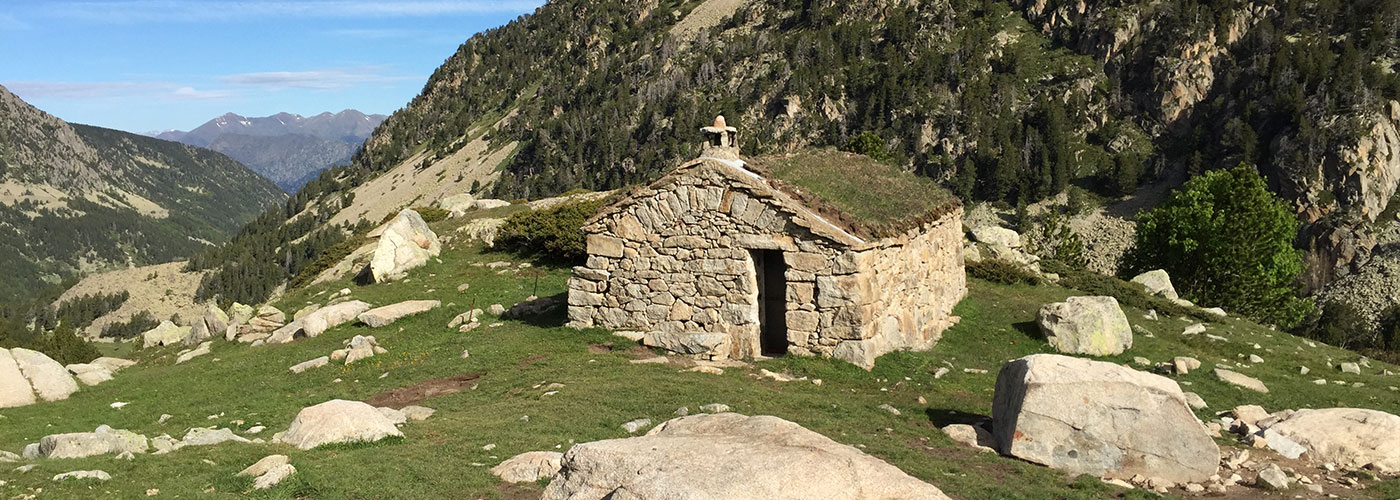
Human occupation within the valley is concentrated in the areas of Ràmio and Entremesaigües, where the inhabitants of the early twentieth century left representative examples of the agricultural and pastoral practices of the time, including orris (traditional pastoral complexes), shepherds’ huts and cultivation terraces, as well as other remains of a more industrial nature, such as an iron forge and mining sites.
Historically, the valley’s economy was based on a close interrelationship between agriculture, livestock farming and ironworking, all of which had to adapt to a demanding landscape and a harsh mountain climate. The land was devoted primarily to agriculture: the valley floor was cultivated to produce crops both for human consumption and for feeding livestock, initially sheep, later horses and subsequently cattle. Livestock farming thus became the other principal economic activity in the valley.
Together, these two activities played a decisive role in shaping the landscape as it can be appreciated today, while also contributing significantly to the area’s biodiversity. The work of generations of farmers and shepherds created many of the characteristic features that now define the valley: the seemingly random mosaic of cultivated fields, hay meadows, cortals—traditional agricultural enclosures once used for growing cereals, legumes and tobacco, or as grazing areas during milder seasons—and the remains of shepherds’ huts and orris, where flocks were managed and sheep’s wool and milk were processed. This long-standing interaction between people and nature has greatly enriched both the valley’s biological diversity and, in a particularly remarkable way, its cultural landscape.
During the eighteenth and nineteenth centuries, pastoral activity coexisted with iron production, and the valley reached one of the highest levels of human occupation in its history. It was during this period that much of the rural landscape visible today took shape.
Livestock farming and pastoral life
The legacy of sheep farming survives in the remains of the orris of Setut, la Rivera dels Orris, Mateu, Planell Gran, Perafita and Turó de l’Estany de la Nou, where sheep were milked and cheese was produced. An orri was often accompanied by a pleta (stone livestock enclosure) used to gather and manage the flock, together with a shepherd’s hut where the shepherd lived. In some cases, the enclosure functioned independently.
Several ruined shepherds’ huts can still be seen throughout the valley—including the four located at l’Estall Serrer—as well as others, dating from the twentieth century, that remain standing at Fontverd, Serrat de la Barracota, Setut, la Farga, Claror, Perafita and els Estanys. These structures bear witness to the intensive pastoral activity that shaped this cultural landscape over the centuries.
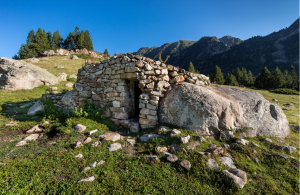
Many of these buildings were constructed using the dry-stone technique. Their construction methods and functions are explained in detail on the Dry-stone Construction page.
Within the cortals, the bordes (traditional mountain barns) and shepherds’ huts are traditional rural buildings in which stone blocks are laid using dry masonry techniques, while the joints are filled with clay. They are among the finest examples of the vernacular architecture of the Madriu-Perafita-Claror Valley. Built from locally sourced stone, earth and timber, they reflect centuries of adaptation to the mountain environment.
Although they share the same materials as dry-stone structures, some specialists do not classify the bordes as true dry-stone buildings. Others include them within this architectural tradition because the stone blocks are assembled without mortar, with only the joints being sealed with clay.
The bordes were agricultural and livestock buildings used on mid-mountain farms. They enabled farmers to cultivate land beyond the main valley floor while overseeing livestock grazing in surrounding pastures. Typically, they comprised two storeys: a stable on the ground floor, where the animals were housed, and an upper floor used to store hay and fodder. Many also included an adjoining shepherd’s hut for overnight accommodation.
Several historic bordes survive throughout the Madriu-Perafita-Claror Valley, either as isolated buildings or grouped within former cortal settlements. Among the most representative are those at Boïgot, Sassanat, Entremesaigües, Ràmio, Fontverd and l’Estall. Archaeological surveys have also documented numerous ruined or partially preserved structures, particularly at Fontverd and Baell, demonstrating that historical occupation of the valley was once even more extensive than the remains visible today suggest.
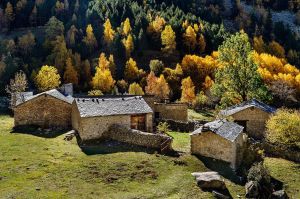
To learn more about daily life and work in this pastoral world, see the page Traditional Activities: Livestock Farming.
Ironworking
Among the remains of the valley’s historic industrial activity—in addition to a sawmill, more than six hundred charcoal platforms distributed throughout the valley, and the open-air iron ore workings at la Maiana—is one of Andorra’s oldest iron forges: the Escaldes or Madriu Forge, located at an altitude of 1,990 metres beside the Madriu River. It remained in operation from 1732 until sometime between 1832 and 1838. Its remote location prevented it from becoming one of the country’s largest forges, but it also made it one of the most distinctive.
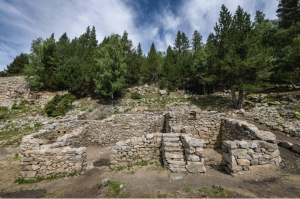
The page Traditional Activities: Ironworking explores this subject in greater depth.
The stone-paved path
The valley’s stone-paved path—also known as the Mountain Path—forms the link between the town of Escaldes and all the activities that have taken place in the valley over the past six centuries. It is also a powerful symbol and an exceptional witness to human presence in the valley. Originally used by farmers, shepherds, ironworkers and muleteers, and later by refugees, travellers and smugglers, it is now followed by hikers as part of the GR-7 long-distance trail, which forms part of the European E4 route stretching from Greece to Gibraltar.
It is one of the valley’s finest examples of dry-stone construction, described in greater detail on the corresponding Dry-stone Construction page .
The FHASA works
The last major human intervention in the valley took place during the 1930s, when FHASA carried out the construction of reservoirs and water collection systems supplying the Engolasters Dam. The Ràmio and l’Illa dams, together with the channels and tunnels excavated to ensure sufficient water flow, are today the most visible evidence of an engineering project that was highly innovative for its time and closely linked to the history of Andorra, as it marked the beginning of the country’s transition from a predominantly rural society towards modernisation.
Despite the impact of these works, a balance with the surrounding landscape was successfully maintained. Infrastructure such as the l’Illa and Ràmio dams, together with the Ràmio dam keeper’s house—one of the finest examples of granite architecture from the first half of the twentieth century—now forms an essential part of the valley’s architectural heritage.
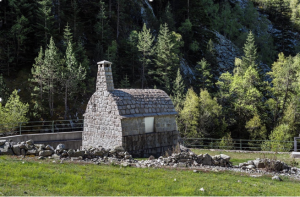
Mountain refuges
During the second half of the twentieth century, as hiking became increasingly popular, mountain refuges were built to provide shelter for walkers. Five are located within the valley—Claror, Perafita, Fontverd, Riu dels Orris and l’Illa (in the parish of Encamp)—while a further four are situated within the buffer zone: Prat Primer, les Àgols, Ensagents and Montmalús.
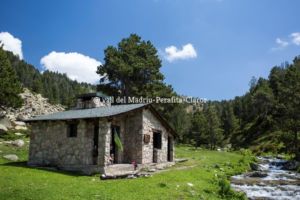
A diverse heritage
The cultural heritage of the Madriu-Perafita-Claror Valley is the result of centuries of human activity carried out in harmony with a demanding mountain environment. Agriculture and livestock farming, ironworking, the use of water resources and dry-stone construction are its most visible expressions. Each of these activities has its own history, which can be explored through the dedicated pages of this website.