

DRY STONE CONSTRUCTION
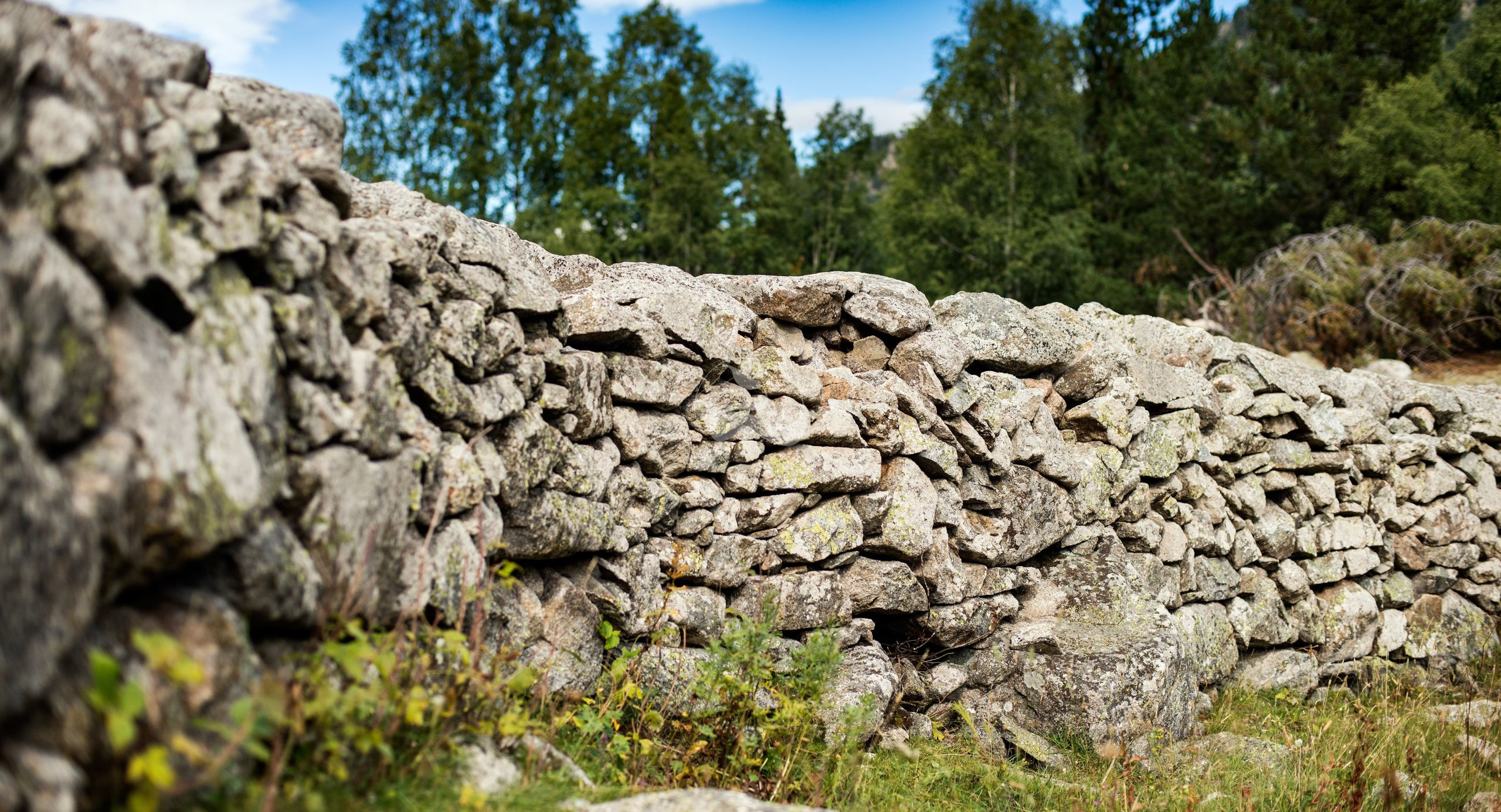
Dry stone construction is one of the most outstanding expressions of the cultural heritage of the Madriu-Perafita-Claror Valley. It consists of stacking stones without any binding material—sometimes with the help of mud—in such a way that the stability of the structure depends solely on the selection and careful placement of each stone.
This technique has made it possible to adapt mountain slopes for agriculture and livestock farming using the minimum of resources and the greatest efficiency, while at the same time respecting the environment and using the material that was found near the implantation site. Dry stone walls, paved surfaces and shepherds’ huts contribute to increasing biodiversity—by providing a habitat for certain species of flora and fauna—to minimising soil degradation and erosion, and to improving the use of rainwater. For this reason, it is considered a paradigm of sustainability: an architecture born from the symbiosis between humankind and nature.
Beyond its material value, dry stone represents an important intangible heritage: the knowledge, skills, and ways of using and interpreting it that have been passed down from generation to generation among the pastoral and farming communities of the valley.
The orris and the pletas
Orris are dry stone structures that were used for milking sheep and obtaining the milk from which cheese was made. In the Madriu-Perafita-Claror Valley, among others, there are the orris of Setut, the Rivera dels Orris, Mateu, Planell Gran, Perafita and Turó de l’Estany de la Nou, all of which are now in ruins.
These structures were mainly used at the beginning of summer, when the flocks were taken up to the mountain pastures. The shepherds separated the ewes that were nursing from the younger animals and allowed only the former to enter the orri. The sheep entered through the wide, open end of the structure, to which a kind of funnel made of wooden hurdles was attached. The sheep moved along the passage formed by the two walls of the orri, whose winding layout was designed to reduce the force of the animals’ forward pressure. The shepherd stood inside the enclosure at the far end of the orri and took the sheep one by one, or in small groups, to milk them. This operation was repeated twice a day.
The milk obtained was used to make cheese, a task carried out by the shepherd in a hut attached to the orri. The same hut also served as the shepherd’s dwelling if no separate hut was available nearby. Attached to the orri, or just a few metres away, there was usually also a pleta. The orri, the pleta and the hut can therefore be regarded as a single unit.
Historian Olivier Codina explains the history of Andorra through the orris in this interview; from minute 13:37 to 18:12 he speaks specifically about the orris of the Madriu-Perafita-Claror Valley [keep link: https://www.rtva.ad/programes/la-rotonda-1part-historia-andorra-orris].
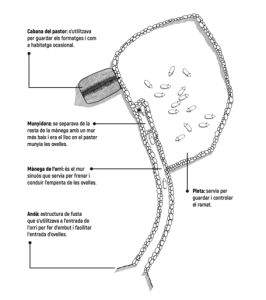
Scheme of operation of an orri
the high mountain shepherd’s huts of the 20th century
In addition to the huts attached to the orris, the valley preserves other independent shepherds’ huts, as are for example the four ruined huts at Estall Serrer, and those at Fontverd, Serrat de la Barracota, Setut, la Farga, Claror, Perafita and els Estanys. Together with pletas such as the one at Estall Serrer or the enclosure at Graus, they formed the network of pastoral infrastructure scattered throughout the valley.
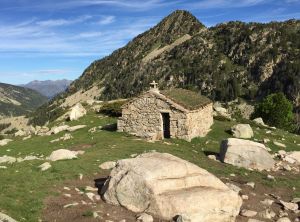
Setut shepherd's hut
the terraces and the edges of mid-mountain cultivation and the cortals
In addition to the structures built to shelter people and livestock, which often appear concentrated in what is called a cortal, dry stone was also used to reclaim land for cultivation on the slopes: terraces—level areas supported by stone retaining walls—made it possible to cultivate land where the steep gradient would otherwise have made it impossible. Today, the mosaic formed by these walls remains one of the most characteristic features of the valley landscape.
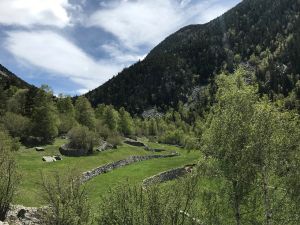
Ramio's terraces
the transverse stone-paved path
The stone-paved path—or Mountain Path—is perhaps its most emblematic work: a stone route, starting from the central valley, that has crossed the valley for six centuries and has been its economic and social link. It was used by farmers, shepherds, ironworkers and paquetaires; later by refugees, travellers and smugglers; and today by hikers from all over the world, as it forms part of the GR-7 long-distance footpath, which is included in the European long-distance route E4 linking Greece and Gibraltar. For all these reasons, it is one of the most outstanding symbols of the history of the valley and of Andorra.
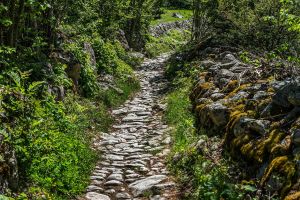
The stone-paved path
A fragile heritage, a universal heritage
Dry stone construction is not exclusive to the Madriu-Perafita-Claror Valley: it is a technique shared by many rural mountain areas throughout the Mediterranean and beyond. In 2018, UNESCO inscribed the art of dry stone construction on the Representative List of the Intangible Cultural Heritage of Humanity, following a joint nomination by eight European countries—Cyprus, Croatia, France, Greece, Italy, Slovenia, Spain and Switzerland.
This international recognition highlights a heritage which, despite its richness, is also fragile: many structures are in ruins or threatened by rural abandonment. From the Madriu-Perafita-Claror Valley we wish to contribute to improving its knowledge, dissemination and integrated conservation, as a living testimony to the relationship between humankind and the mountains.